New Robotic Control Software Enables Seamless Skill Transfer Between Different Robot Arms
The Challenge of Switching Robot Hardware
Switching from one smartphone to another is a relatively smooth experience — logging into your accounts typically syncs your apps, preferences, and contacts onto the new device. In robotics, however, swapping an old robotic arm for a newer model has traditionally meant starting from scratch. Every robot has unique kinematic properties: different joint limits, link lengths, and ranges of motion. Skills learned on one robot cannot simply be copied to another. This has long been a bottleneck in deploying robots across manufacturing, logistics, and healthcare settings, where hardware upgrades or replacements are common.
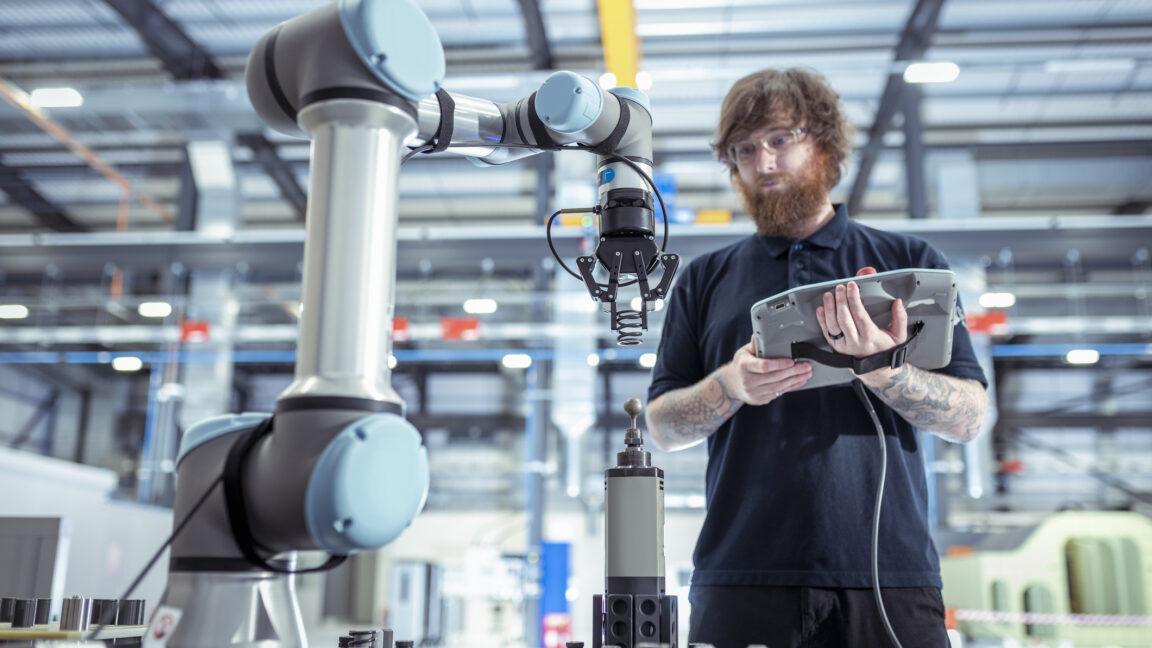
When a robot learns a task — such as wiping a table or stacking boxes — the motion trajectories become tightly coupled to its specific physical configuration. Attempting to replay those same motions on a different robot often leads to joint jamming, where one or more joints reach their mechanical limits, causing the robot to stall or even damage itself. This problem not only wastes time and resources but also limits the reusability of valuable training data.
Introducing Kinematic Intelligence: A Smartphone-Like Experience
To address this, a team of researchers at the Swiss École Polytechnique Fédérale de Lausanne (EPFL) has developed a new framework they call Kinematic Intelligence. Described in a recent Science Robotics paper (read the full article), the system aims to make switching robots as effortless as switching smartphones. By automatically adapting learned motions to a new robot's kinematic capabilities, Kinematic Intelligence avoids joint jamming and ensures smooth, safe operation across different hardware platforms.
Learning from Demonstration and Its Limitations
For years, roboticists have championed learning from demonstration — a technique where a human teaches a robot a new skill by physically guiding its arm or remotely controlling it. This approach is intuitive and eliminates the need for complex programming. For instance, a worker could manually move a robotic arm through the motions of welding a car component, and the robot would record the trajectory for later reuse. However, the recorded skill is inherently tied to the specific robot used during training. If the robot is later replaced with a model of different dimensions or joint arrangement, the recorded motions become invalid — often leading to jamming or incomplete tasks.
How Kinematic Intelligence Solves the Transfer Problem
The EPFL team’s framework tackles this by introducing a layer of abstraction between the skill and the robot's physical hardware. Instead of storing raw joint angles, Kinematic Intelligence captures the geometric intent of the motion — for example, the path of the end-effector relative to objects. When transferring to a new robot, the software recalculates a trajectory that respects the new robot's joint limits while preserving the original motion's outcomes. It uses an optimization algorithm that minimizes deviation from the intended path while never exceeding any joint's mechanical stop.
This approach is akin to how a smartphone syncs your contacts: the data (the skill) is stored in a device-agnostic format, and the system (the robot’s controller) intelligently adapts it to the new hardware. The result is a significant reduction in setup time and a dramatic decrease in the risk of joint jamming. The researchers demonstrated the framework across several different robot arms, performing tasks such as pick-and-place, surface wiping, and assembly — all without manual re-tuning.
Benefits and Future Applications
The practical implications are wide-reaching. In manufacturing, companies can upgrade robotic cells without retraining every skill from scratch. In service robotics, a robot that learns to fold laundry in one home could be deployed to another home with a different arm model. The framework also opens the door to collaborative training — multiple robots of varying types could share a common skill database, each executing tasks in a way that suits their own kinematics.
Moreover, by avoiding joint jamming, Kinematic Intelligence reduces wear and tear on physical components, lowering maintenance costs and improving robot longevity. The EPFL team is already exploring extensions to mobile manipulators and humanoid robots, where the challenge of transfer is even greater due to complex whole-body motion.
Conclusion
The EPFL’s Kinematic Intelligence framework marks a significant step toward making robotic systems as user-friendly and interoperable as consumer electronics. By decoupling learned skills from specific hardware, it eliminates the recurring nightmare of joint jamming during hardware transitions. As robotics continues to spread across industries, such flexibility will be crucial for enabling rapid deployment and reuse of training data. The researchers hope their work will inspire further efforts to standardize skill representations, much like how app ecosystems have standardized data formats.
For those interested in the technical details, the full paper is available in Science Robotics (jump to challenge or learn about the framework).